
- Buy Crypto
- Markets
- Futures
- Spot
- Copy Trade
 Earn
Earn- More
Brevis Pico: A High-Performance Modular General-Purpose ZK Virtual Machine

Source: Brevis

The Brevis team is excited to introduce Pico — a modular and efficient zero-knowledge virtual machine (zkVM). Pico allows developers to flexibly build a zkVM tailored to their application's computational needs, similar to assembling LEGO bricks, in order to optimize performance and user experience. Developers can freely choose from a rich set of built-in options, and even fully customize the proof backends and VM instances to create a bespoke computational flow that meets their specific requirements.
Pico redefines the "Glue-and-Coprocessor" architecture, supporting not only underlying coprocessors (such as using precompiled modules to accelerate specific VM instruction operations) but also natively integrating Brevis' on-chain data zkCoprocessor, boosting application performance utilizing blockchain historical data by up to 32 times.
While a complete GPU-accelerated cluster solution for Pico has yet to be introduced, it has already achieved world-class performance on the CPU side. Compared to other industry zkVMs like RISC0, SP1, and OpenVM, Pico boasts a CPU speed improvement of 70% to 155%, setting a new performance benchmark.
With the release of Pico v1.0, we have introduced the world's first zkVM supporting a customizable compute architecture, allowing developers to adjust the following key parameters flexibly:
Selectable Proof Backend: Supporting STARK on KoalaBear and BabyBear, as well as CircleSTARK on Mersenne31.
Flexible Proofing Process: Optimizing security, scalability, proof generation efficiency to adapt to various application requirements.
On-chain Historical Data Access: Through the built-in on-chain data zkCoprocessor, developers can freely query, compute historical blockchain data to build dApps, achieving optimal computational performance and programming flexibility.
Pico is compatible with the RISC-V instruction set and supports the Rust development toolchain. Due to its modular architecture, Pico is future-proof and can easily adapt to the latest ZK theoretical research innovations. Whether it's the next generation of ZK applications or cutting-edge explorations in the ZK field, Pico provides developers with a stable and powerful computing foundation.
Feel free to visit the Pico Developer Guide, explore the GitHub code repository, and join the Telegram or Discord discussion groups to stay updated and contribute, together shaping the future of ZK computing.
Why Pico?
Brevis's first product—the on-chain data zkCoprocessor—has been widely used in DeFi and other fields. Many partners have deployed innovative features based on Brevis on the mainnet, including Kwenta, Usual, Algebra Labs, JoJo Exchange, Trusta, and more. In addition, PancakeSwap, Celer, Gamma, Quickswap, Frax, Mask Network, Kernel, BeraBorrow, Thena, Kim Protocol, 0G, Bedrock, Mellow Finance, ZettaBlock, Hemera
and Mendi Finance and other top protocols and applications are also developing next-generation products and features based on Brevis.
However, in the process of collaborating with these cutting-edge teams, we found that the practical application needs of zk computation are becoming more diverse and face the following core challenges:
1. Adapting to Different Application Needs
The business logic of different projects varies, and their performance requirements differ greatly. The traditional "one-size-fits-all" zkVM or fixed ZK circuit solutions struggle to meet the changing needs. If there is a lack of flexible customization of the proof process or an inability to integrate custom circuits (whether at the opcode level or application level), the scalability of zkVM will be limited.
2. Embracing Cutting-Edge ZK Technology
The ZK field is rapidly evolving, with new proof backends, frameworks, and cryptographic breakthroughs emerging constantly. Many existing zk solutions, due to their closed architecture, find it challenging to quickly integrate these innovative technologies, resulting in outdated proofs, poor performance, high computational costs, and limited optimization space.
Pico's Modular Approach: Truly Flexible and Scalable
To address these challenges, Pico adopts a modular architecture, providing:
· Support for Multiple Proof Backends: Easily switch or upgrade to the latest proof backend to ensure computational performance and compatibility.
· Customizable Proof Processes: Developers can freely customize the proof generation pipeline to meet specific application requirements.
· Scalable Coprocessor Integration: Supporting the building or integration of dedicated coprocessors, without being limited to a fixed zkVM framework.
Innovative Glue-and-Coprocessor Architecture: Breaking Through the Bottleneck of Traditional zkVM
Pico adopts the "Glue-and-Coprocessor" architecture, combining efficient dedicated circuits (Coprocessors) with a universal zkVM (Glue) to balance performance, generality, and scalability.
Coprocessors: Optimize intensive tasks such as arithmetic operations, cryptographic computations, machine learning, etc., to enhance ZK proof efficiency.
Universal zkVM (Glue): Manages the overall proof and verification process to ensure all logical computations can proceed securely.
What are the advantages of this architecture?
Compared to traditional zkVMs, Pico achieves faster proof generation and higher programmability by combining the generality and computational power of dedicated circuits.
Precompiles are a common type of coprocessor that extends the RISC-V instruction set to accelerate fundamental operations like hashing and signature verification. Pico supports developers in customizing precompiled modules based on their requirements and offers out-of-the-box optimization solutions.
However, relying solely on precompiles is insufficient to meet all application performance needs. For example, if a developer wants to prove that a trader executed 10,000 Uniswap trades totaling $50 million in the past 30 days, performing the computation using only zkVM would require writing Merkle tree inclusion proofs and RLP decoding programs, incurring high costs.
How to overcome this limitation?
Pico natively integrates Brevis's on-chain data zkCoprocessor as an application-level coprocessor, enabling developers to efficiently access and compute on-chain historical data, achieving a 32x performance improvement while reducing costs by 67%.

Table 1: Performance Comparison between Coprocessor-Enhanced Pico and Native Pico (4096 transactions, log size: 40)
Pico further extends this architecture to support verifiable AI inference, Reth, and other application-level coprocessors to further enhance zk computation efficiency.
By combining Coprocessors and the universal zkVM (Glue), Pico provides developers with a powerful and flexible tool to balance performance, programmability, and adaptability in ZK-driven applications.
Flexible Proof Backend with Customizable Computing Flow
1. Flexible Support for Multiple Proof Backends
Pico is compatible with multiple zero-knowledge proof systems, including:
STARK (KoalaBear, BabyBear)
CircleSTARK (Mersenne 31)
For example, the Poseidon2 hash function is widely used in zkVM recursive proofs. Under the same STARK system, KoalaBear proof efficiency far exceeds BabyBear, and a significant performance improvement can be achieved by simply switching the proof backend without modifying the computing logic.
2. Customizable Proof Workflow
Pico allows developers to freely adjust the proof generation process to optimize scalability, cost, and latency.
· Instance-Level Optimization: Developers can customize the computing flow of each VM instance (including proof backend, computing chip, memory management, etc.).
· ProverChain Proof Chain: Through modular processes such as RISCV → CONVERT → COMBINE → COMPRESS → EMBED → ONCHAIN, computing efficiency is optimized.
· Optional Decentralized Verification: Developers can choose whether to conduct on-chain verification on the EVM based on their needs to balance performance and decentralization.
Setting New Industry Performance Records: Establishing the New Benchmark for zkVM
In the latest performance benchmark tests, Pico has comprehensively surpassed existing zkVM solutions and demonstrated remarkable performance improvements in a CPU computing environment. We compared RISC0, SP1, and OpenVM, covering the following core computing tasks:
· Fibonacci Calculation
· Tendermint Block Consensus
· Ethereum Reth Block #17106222 Proof
All tests were conducted on an AWS r7a.48xlarge instance (192-core CPU, 1.5TB RAM) to ensure the consistency of the computing environment. The results show:
· Pico's runtime in all tasks is faster than the second fastest solution by up to 155%, setting a new performance record for zkVM computation!
· Pico's CPU computational power is significantly ahead, especially suitable for applications requiring efficient computation.
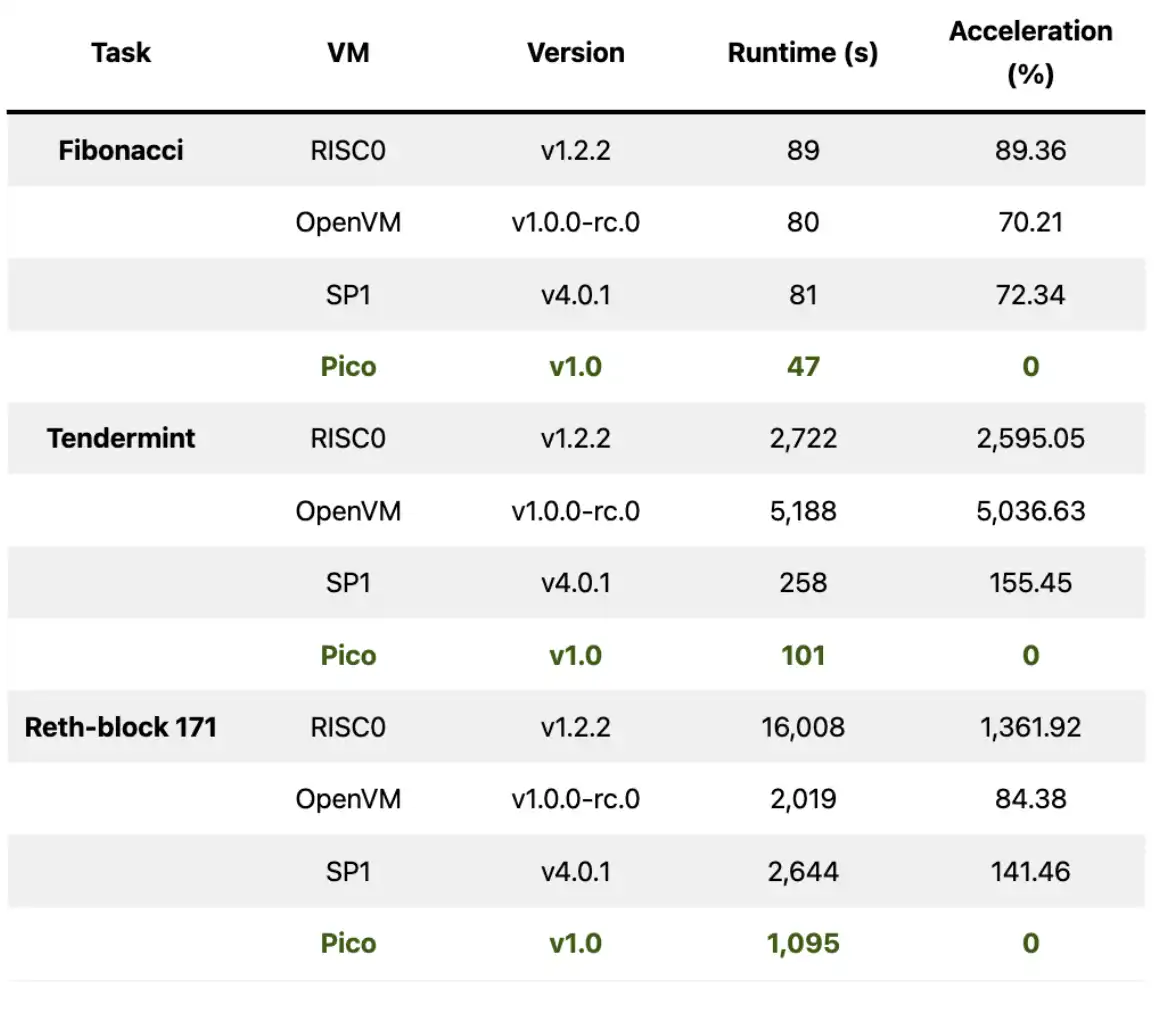
Table 2: Performance Benchmark Test Results of RISC0, OpenVM, SP1, and Pico on Fibonacci, Tendermint, and Reth-block 171 tasks on AWS r7a.48xlarge (192-core, 1.5TB memory)
GPU Accelerated Version Coming Soon
While the current data is based on CPU testing, Pico is developing a GPU-accelerated version expected to be released in the coming months. The GPU-accelerated version of Pico will further enhance zk computation capabilities, providing increased throughput and computational efficiency. A comprehensive GPU performance test report will be released in the future.
Standing on the Shoulders of Giants
Pico draws inspiration from the following projects, each representing cutting-edge advancements in zero-knowledge proof systems.
By building on these innovative foundations, Pico offers a modular and high-performance zkVM:
Plonky3: Pico's proof backend is based on Plonky3, extending its modular features to the zkVM layer, allowing developers to flexibly choose the proof domain and proof system that best suit their applications.
SP1: Pico gains important insights from SP1's chip design and constraint system, including the design of the recursion compiler and precompiles.
Valida: Pico's implementation of cross-table lookups is inspired by Valida's pioneering work in this field.
RISC0: Pico's Rust toolchain is directly based on the toolchain originally developed for RISC0.
Join the Pico Developer Community
Brevis has always believed that the future of zero-knowledge technology lies in collaboration and innovation. Pico is not just a zkVM but also a development platform that empowers building the next generation of zk applications.
· Read the Pico Developer Documentation: Pico Docs
· Explore the GitHub Repository: GitHub Repo
· Join the Community Discussions: Telegram or Discord
Let's work together to expand the boundaries of zero-knowledge computing and to build an intelligent, trustless, decentralized world!
This article is contributed content and does not represent the views of BlockBeats.
You may also like

Russia’s Largest Bitcoin Miner BitRiver Faces Bankruptcy Crisis – What Went Wrong?
Key Takeaways BitRiver, the largest Bitcoin mining operator in Russia, faces a bankruptcy crisis due to unresolved debts…

Polymarket Predicts Over 70% Chance Bitcoin Will Drop Below $65K
Key Takeaways Polymarket bettors forecast a 71% chance for Bitcoin to fall below $65,000 by 2026. Strong bearish…

BitMine Reports 4.285M ETH Holdings, Expands Staked Position With Massive Reward Outlook
Key Takeaways BitMine Immersion Technologies holds 4,285,125 ETH, which is approximately 3.55% of Ethereum’s total supply. The company…

US Liquidity Crisis Sparked $250B Crash, Not a ‘Broken’ Crypto Market: Analyst
Key Takeaways: A massive $250 billion crash shook the cryptocurrency markets, attributed largely to liquidity issues in the…

Vitalik Advocates for Anonymous Voting in Ethereum’s Governance — A Solution to Attacks?
Key Takeaways Vitalik Buterin proposes a two-layer governance framework utilizing anonymous voting to address collusion and capture attacks,…

South Korea Utilizes AI to Pursue Unfair Crypto Trading: Offenders Face Severe Penalties
Key Takeaways South Korea is intensifying its use of AI to crack down on unfair cryptocurrency trading practices.…

Average Bitcoin ETF Investor Turns Underwater After Major Outflows
Key Takeaways: U.S. spot Bitcoin ETFs hold approximately $113 billion in assets, equivalent to around 1.28 million BTC.…

Japan’s Biggest Wealth Manager Adjusts Crypto Strategy After Q3 Setbacks
Key Takeaways Nomura Holdings, Japan’s leading wealth management firm, scales back its crypto involvement following significant third-quarter losses.…
CFTC Regulatory Shift Could Unlock New Opportunities for Coinbase Prediction Markets
Key Takeaways: The U.S. Commodity Futures Trading Commission (CFTC) is focusing on clearer regulations for crypto-linked prediction markets,…
Hong Kong Set to Approve First Stablecoin Licenses in March — Who’s In?
Key Takeaways Hong Kong’s financial regulator, the Hong Kong Monetary Authority (HKMA), is on the verge of approving…

BitRiver Founder and CEO Igor Runets Detained Over Tax Evasion Charges
Key Takeaways: Russian authorities have detained Igor Runets, CEO of BitRiver, on allegations of tax evasion. Runets is…

Crypto Investment Products Struggle with $1.7B Outflows Amid Market Turmoil
Key Takeaways: The recent $1.7 billion outflow in the crypto investment sector represents a second consecutive week of…

Why Is Crypto Down Today? – February 2, 2026
Key Takeaways: The crypto market has seen a downturn today, with a significant decrease of 2.9% in the…

Nevada Court Temporarily Bars Polymarket From Offering Contracts in the State
Key Takeaways A Nevada state court has temporarily restrained Polymarket from offering event contracts in the state, citing…

Bitcoin Falls Below $80K As Warsh Named Fed Chair, Triggers $2.5B Liquidation
Key Takeaways Bitcoin’s price tumbled below the crucial $80,000 mark following the announcement of Kevin Warsh as the…

Strategy’s Bitcoin Holdings Face $900M in Losses as BTC Slips Below $76K
Key Takeaways Strategy Inc., led by Michael Saylor, faces over $900 million in unrealized losses as Bitcoin price…
Trump-Linked Crypto Company Secures $500M UAE Investment, Sparking Conflict Concerns
Key Takeaways A Trump-affiliated crypto company, World Liberty Financial, has garnered $500 million from UAE investors, igniting conflict…

Billionaire Michael Saylor’s Strategy Buys $75M of More Bitcoin – Bullish Signal?
Key Takeaways Michael Saylor’s firm, Strategy, has significantly increased its Bitcoin holdings by acquiring an additional 855 BTC…
Russia’s Largest Bitcoin Miner BitRiver Faces Bankruptcy Crisis – What Went Wrong?
Key Takeaways BitRiver, the largest Bitcoin mining operator in Russia, faces a bankruptcy crisis due to unresolved debts…
Polymarket Predicts Over 70% Chance Bitcoin Will Drop Below $65K
Key Takeaways Polymarket bettors forecast a 71% chance for Bitcoin to fall below $65,000 by 2026. Strong bearish…
BitMine Reports 4.285M ETH Holdings, Expands Staked Position With Massive Reward Outlook
Key Takeaways BitMine Immersion Technologies holds 4,285,125 ETH, which is approximately 3.55% of Ethereum’s total supply. The company…
US Liquidity Crisis Sparked $250B Crash, Not a ‘Broken’ Crypto Market: Analyst
Key Takeaways: A massive $250 billion crash shook the cryptocurrency markets, attributed largely to liquidity issues in the…
Vitalik Advocates for Anonymous Voting in Ethereum’s Governance — A Solution to Attacks?
Key Takeaways Vitalik Buterin proposes a two-layer governance framework utilizing anonymous voting to address collusion and capture attacks,…
South Korea Utilizes AI to Pursue Unfair Crypto Trading: Offenders Face Severe Penalties
Key Takeaways South Korea is intensifying its use of AI to crack down on unfair cryptocurrency trading practices.…


 App
App